

May 2026
Our Historic Mount Pleasant Journal strives to inform community members by illuminating historic district building requirements and its history.
By Jonathan Herz
From The House of Mercy to the Rosemount Center
The Rosemount Center at 2000 Rosemount Avenue NW is more than a neighborhood childcare center. For over a century, it has reflected shifting ideas about charity, family, immigration, and the role of historic places in Washington, D.C. Its recent recognition on the National Register of Historic Places underscores both its architectural distinction and its deep social history.
Good Work Being Done
The Association for the Works of Mercy, later known as the House of Mercy, was founded in January 1884 by members of the Woman’s Auxiliary to St. John’s Episcopal Church, as a “house of refuge and reformatory for fallen and outcast women.” A board of “lady managers” and “twelve gentlemen” trustees led the organization.
The institution originally served unwed white mothers and their babies at a time when few alternatives existed and the stigma surrounding single motherhood was severe. Its programs emphasized domestic training and support, helping women build skills and offering a refuge for those who had few other places to turn. Throughout its history, funding the House of Mercy was a constant challenge. By 1898 it was described as absolutely bankrupt, reflecting the difficulties of sustaining charitable work for marginalized women in that era. Through the fundraising efforts of the lady managers, the House was able to remain open.
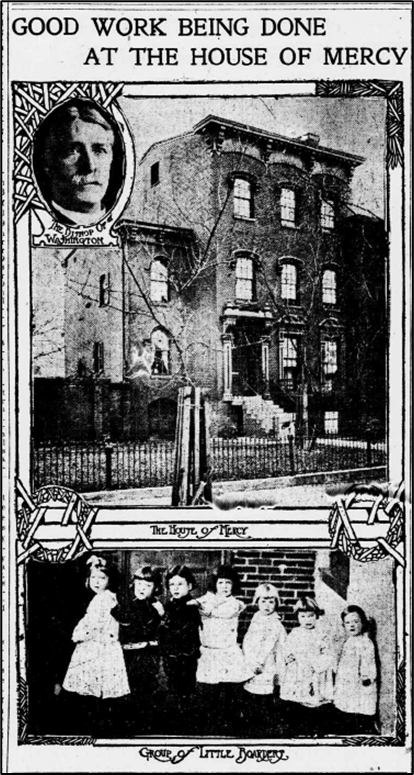
| The Evening Star, December 14, 1907 |
A Patron Steps Up
As the president of the Church’s House of Mercy lady managers, Mrs. Julian James organized numerous fundraisers to support it and in 1910, donated land and $60,000 to the Association for Works of Mercy to allow it to move from its old, “long since inadequate” quarters at 2408 K St. NW to a site “Nestled in the woods bordering Rock Creek Park and fashioned after the ancient Spanish missions, with high walls surrounding its spacious grounds… one of the most completely equipped institutions of its kind in the country.” She also provided it with an endowment that would generate an income of $850 a year to pay part of its expenses for maintaining and operating the home, with the balance coming through the fundraising efforts of the managers and trustees. To ensure that such a facility would always continue to exist in the city, the property was donated to the Association for Works of Mercy with a deed proviso that it was “to be used for the erection of a house or home to be known as the House of Mercy for unfortunate young girls and their children in the District of Columbia,” and that the House of Mercy “shall have power to sell the said land only for the purpose of re-investing in other real estate in the District of Columbia to be used solely for the purposes of said Association for works of mercy.”
Mrs. Cassie Julian James in 1908.
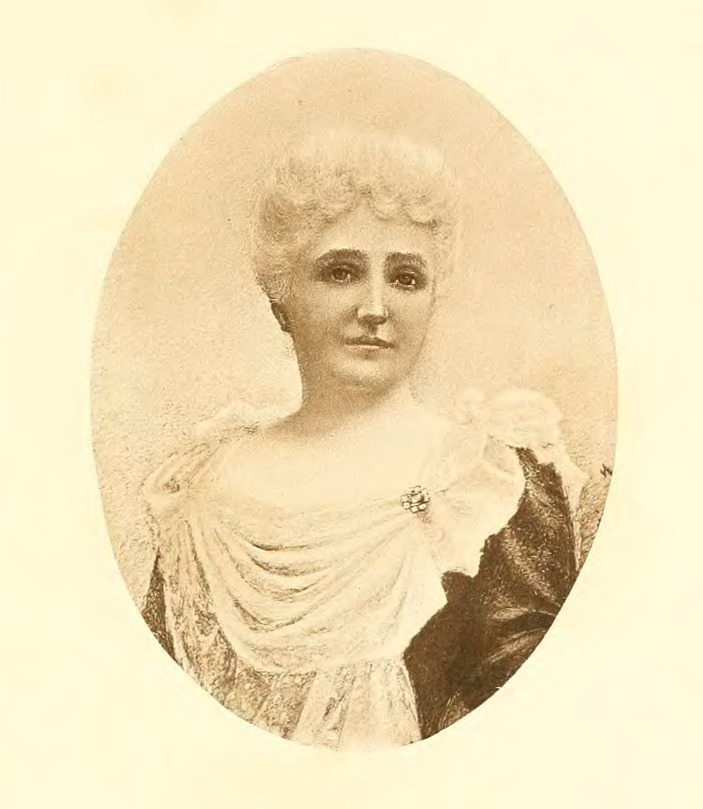
As the president of the Church’s House of Mercy lady managers, Mrs. Julian James organized numerous fundraisers to support it and in 1910, donated land and $60,000 to the Association for Works of Mercy to allow it to move from its old, “long since inadequate” quarters at 2408 K St. NW to a site “Nestled in the woods bordering Rock Creek Park and fashioned after the ancient Spanish missions, with high walls surrounding its spacious grounds… one of the most completely equipped institutions of its kind in the country.” She also provided it with an endowment that would generate an income of $850 a year to pay part of its expenses for maintaining and operating the home, with the balance coming through the fundraising efforts of the managers and trustees. To ensure that such a facility would always continue to exist in the city, the property was donated to the Association for Works of Mercy with a deed proviso that it was “to be used for the erection of a house or home to be known as the House of Mercy for unfortunate young girls and their children in the District of Columbia,” and that the House of Mercy “shall have power to sell the said land only for the purpose of re-investing in other real estate in the District of Columbia to be used solely for the purposes of said Association for works of mercy.”
A House with a Purpose
The resulting building was designed by Nathan C. Wyeth, one of Washington’s most prominent architects, in a Mission-Spanish Colonial Revival style. It was completed in 1911 in a secluded setting overlooking Rock Creek Park. The form and materials gave the place a calm, sheltering character that matched its original purpose as a sanctuary. Wyeth’s work on the project stands out for its dignified integration with the landscape above Rock Creek Park, and the building retains many original features despite later renovations. Among Wyeth’s other notable works were the Longworth House Office Building, the West Wing of the White House and the first Oval Office, and the Francis Scott Key Bridge in Georgetown.
The Evening Star, September 25, 1911
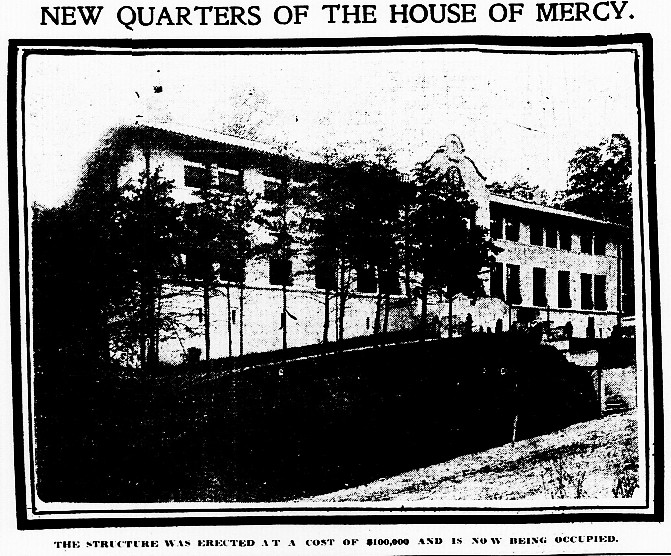
Fundraising and Support from Well-Known Society Ladies
Mrs. Julian James’ patronage attracted many of Washington’s most distinguished women to support the home through fundraising social activities to supplement the endowment. In newspaper articles over the years, the House of Mercy’s activities were often described as the highlight of the season. A January 1911 article described one event: “Quite the smartest audience of the season assembled at the Columbia Theater yesterday afternoon to see the Baltimore society amateurs in the clever play, ’The Importance of Being Ernest,’ for the benefit of the House of Mercy.” President and Mrs. Taft and Mrs. John R. McLean (whose husband owned the Washington Post) were among the patrons who took boxes. In November 1913, “living pictures,” re-created by society ladies posing as the characters in fifteen of the world’s most famous paintings were exhibited at the Columbia Theater for the benefit of the House of Mercy. Among the “paintings” were Delia Robbia’s “Angel” and Stephen Lochner’s “Angel of the Annunciation.” Music for the occasion was furnished by St. John’s Church choir.
By 1924, annual garden parties to “Raise Funds to Help Work for Unfortunate Mothers and Children” were being held in the Cathedral Close, or gardens, at Mount St. Albans where the National Cathedral was then under construction. As noted in the Star, It was hoped that the House of Mercy fete that year would “be even more successful than in former years, as the work done is increasing and the budget must be larger to carry on the expanding program… Last year the profits from the lawn fete amounted to nearly $2,000 [just enough to keep] the Association for Works of Mercy from running behind last year and ruining its fine record.”
The May 19, 1933 Evening Star reported that “approximately 1,000 persons prominent in the city’s social life” attended the House of Mercy’s annual fund-raising garden party in the Cathedral gardens.
In 1954, Mrs. Dwight Eisenhower and Mrs. Richard Nixon headed the list of patronesses for the 26th annual food and apron sale of the House of Mercy. The sale was officially opened by the wife of the Netherlands Ambassador. “A Netherlands Christmas” was the special theme of the sale. The White House sent a cake. Starting in 1937 and lasting through the 1960s, a big fundraising event was the “Phantom Dinner,” where the only real things were the contributions.
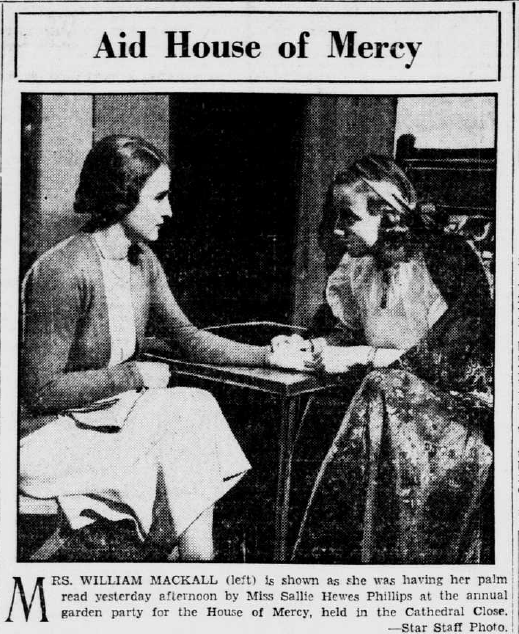
By 1924, annual garden parties to “Raise Funds to Help Work for Unfortunate Mothers and Children” were being held in the Cathedral Close, or gardens, at Mount St. Albans where the National Cathedral was then under construction. As noted in the Star, It was hoped that the House of Mercy fete that year would “be even more successful than in former years, as the work done is increasing and the budget must be larger to carry on the expanding program… Last year the profits from the lawn fete amounted to nearly $2,000 [just enough to keep] the Association for Works of Mercy from running behind last year and ruining its fine record.”
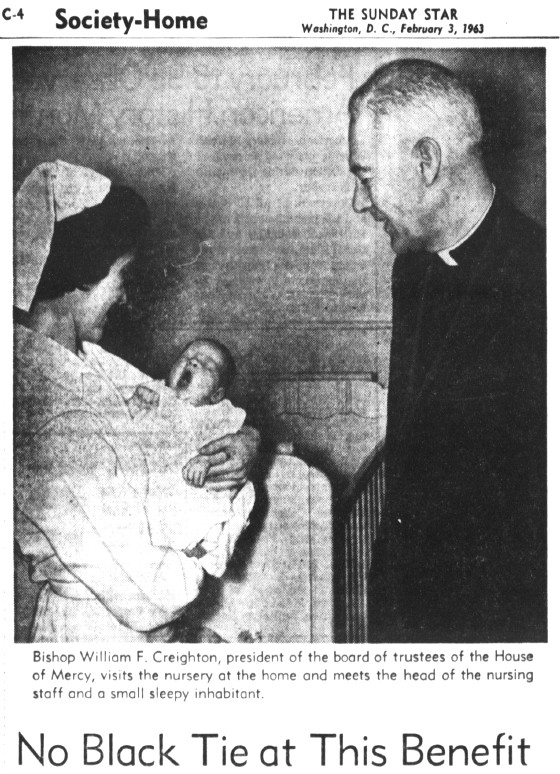
The May 19, 1933 Evening Star reported that “approximately 1,000 persons prominent in the city’s social life” attended the House of Mercy’s annual fund-raising garden party in the Cathedral gardens.Tickets in 1960 were $5 each. The 1960 Sunday Star noted, “Last year one “guest” bought two “tickets” and added a 15 per cent tip for the phantom waitress.” About the 1963 Phantom Dinner, the Sunday Star wrote, “the longest and simplest -benefit of the year has already begun… the “guests” are those who send donations to the House of Mercy. They feed on nothing more than satisfaction— every bit of the proceeds go toward the work of the home.”
Bishop William F. Creighton at the House of Mercy in 1963.
Changing With the City
In 1960, the Episcopal Diocese of Washington directed that its institutions and services be offered to all people without regard for race or color. In 1963, after the diocese issued an ultimatum to the House of Mercy – the Diocese’s oldest existing charity – to integrate or lose affiliation and funding from the diocese – it finally did.
By 1972, in response to the lessening stigma around single motherhood, the House of Mercy created the Rosemount Center as an independent 501(c)(3) organization, shifting from a residential model to focusing on Center-based and home-based children infant day care, which continues today. Pioneering bilingual early childhood education, the Center provides childcare for Mount Pleasant and Adams Morgan, serving Spanish-speaking and other families. In 1982, the Center became affiliated with the federal HeadStart Program and in 2004, was given a 20-year lease by the House of Mercy at $1/year.
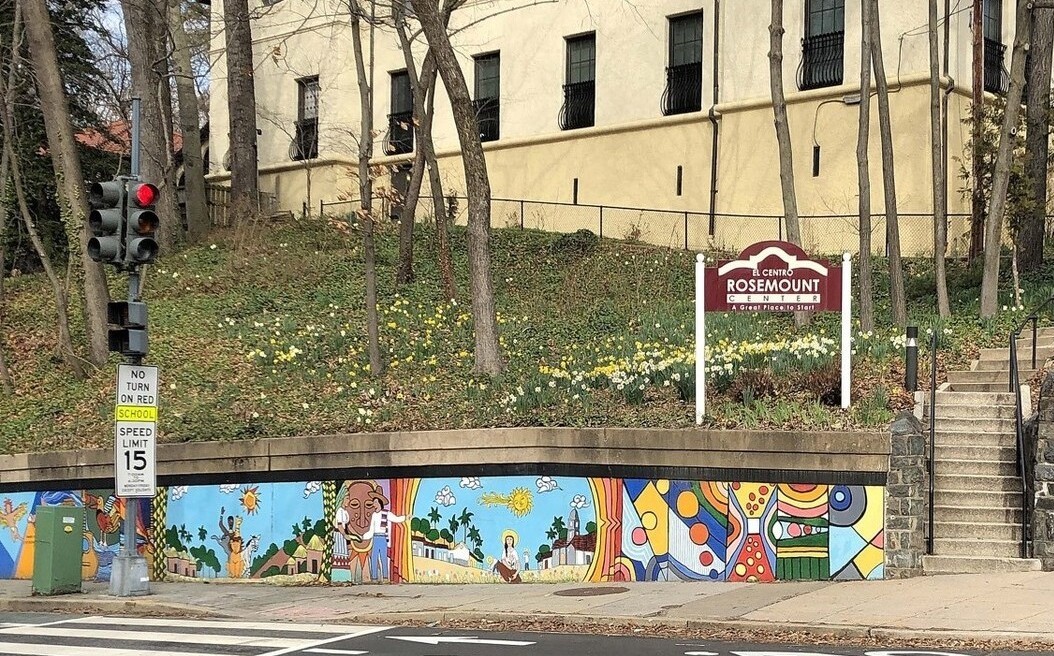
In addition to its historic building, the Center is also notable for the mural along Klingle Road, “Canto a la Esperanza (A Song for Hope),” designed by Jorge Somarriba and painted by Latin American Youth Center members between 1988 and 1990.
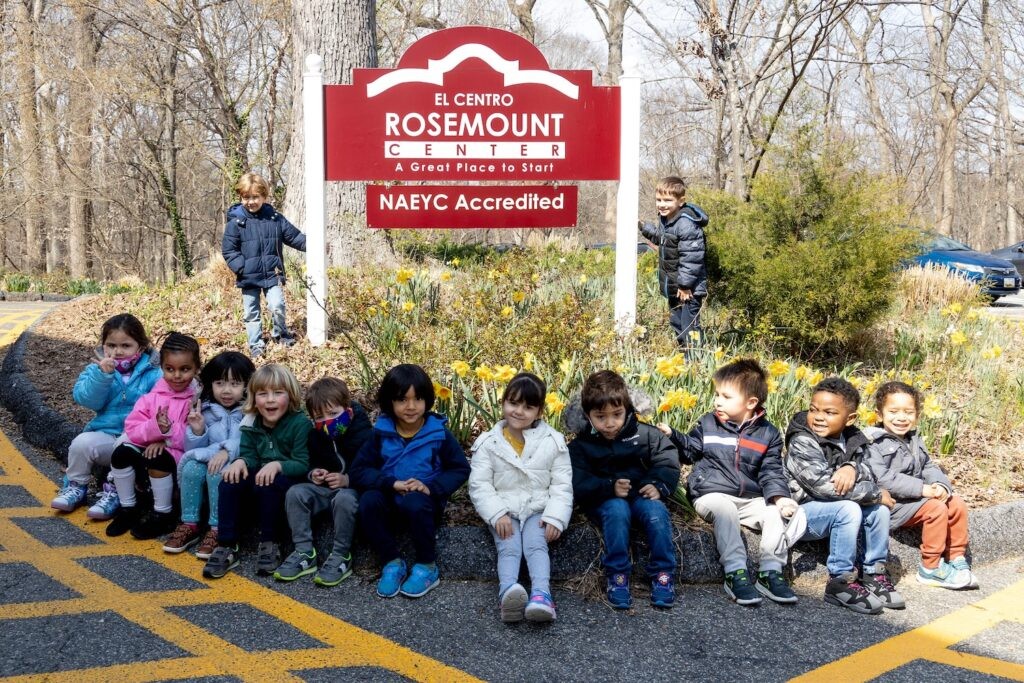
Today, the Rosemount Center describes itself as a bilingual, multicultural early childhood program serving more than 240 families through a mix of family support, tuition, and public subsidies. It remains closely tied to the original mission of helping those with the greatest need, even as the form of that help has changed.
View of the Rosemount mural. Photo by John DeFerrari.
The End of an Era
In 2022, the House of Mercy announced that the $1/year lease was no longer fiscally sustainable and would not be renewed when it expired and gave the Center two years to relocate. According to a February 15, 2024 Washington Post article, the Rosemount Center offered to pay off the mortgage taken to pay for renovations to the Center and proposed “significant rental payments.” The House of Mercy said it never received the offer to assume the mortgage, nor did it get a “market-value based offer” to rent the property.
The current Episcopal bishop of Washington, the Right Rev. Mariann Budde, who was the House of
Children at the Rosemount Center in 2026. Photo from the Rosemount Center website.
Mercy’s Board Chair from 2012 until 2019, told the Post that while the church is no longer directly involved with the charity, she tried to work with the House of Mercy and Rosemount to find a way for the Center to continue. Since then, the Center has been able to re-negotiate and extend their lease at $335,000/year through August 2027 and now has an option to purchase the property for $7 million. The House of Mercy has not said how it will use the proceeds from the sale.
View of the Rosemount mural. Photo by John DeFerrari.
A New Fundraising Push
As its predecessor, the House of Mercy, did in 1898, the Rosemount Center is once again facing the choice of raising substantial funds or closing its facility. As of May 2026, the Rosemount Center’s current campaign has received a $2 million D.C. Council FY 2026 grant and $1 million D.C. government matching funds after raising $1.352 million in private donations, exceeding a $1.25 million goal set by the District.

Adam Ain, the Rosemount Capital Campaign Chair and Senior Advisor, announced that they are now working on obtaining the remaining $2.65 million through additional D.C. funding, a Head Start capital grant, a mortgage, and continued fundraising.
Conclusion
Rosemount’s story is really a Washington story, changing from elite philanthropy to primarily public funding for social services, with private donations remaining essential in preserving the institution. The property changed from a refuge for marginalized women and their children to a bilingual center serving parents and young children at the Rosemount Campus and in their homes, and from a secluded estate on the edge of Mt. Pleasant to an institution woven into the life of the neighborhood.